
Gray & Colored Concrete Floors
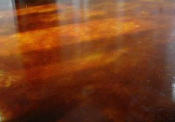

Acid based stains that create unusual variegated coloring in reaction with the chemicals in the cured, but relatively new concrete slab.
Older concrete slabs may not achieve the desired color effects due to the change in the chemical structure of the concrete as it ages.
Acid staining is a permanent chemical reaction with the concrete. Using our "Premium Stripper" should not effect this color treatment and the only way to remove the color is by grinding. However, test first - no surprises!
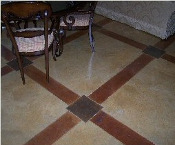
Iron oxide pigment powders that are integral to the concrete mix or are worked into the still wet surface of a newly poured slab.
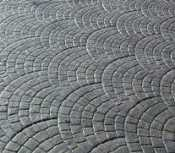
The techniques for patterning are varied. They can be "stamped" into the surface, vibrated into the surface, cut into the surface, and more.
Further "Items of Interest" for this surfacing, and all others, are at the bottom of this page.

Your Choices for Sealing
This surface is usually low absorption.
Our suggestions to test are:- Penetrating petroleum solvent formulas with acrylic solids. These can be sprayed to finish nicely, but solids level might need to be adjusted if manufacturer allows dilution.
- Water based film forming that can flow out and self-level.
- Water based penetrating that is usually invisible when dry.
- Click here to see What effects you can expect from each sealer type.
- Click here to see our suggested sealers, cleaners, and application tools.
Some questions you may not be thinking to ask right now that could become important:
. Was it sealed in the past? Does that matter?
. Will a new sealer be compatible with whatever was used before?
. What sealer will give the visual results you want?
. Will you also be able to have a sealer solve problem(s)? ( Answer: yes. Just know which to pick.)
Items of Interest
How to select a sealer
A sealer can do far more than just bead water and look pretty! To see what that is click here.
Important: If your project has had any sealer applied in the past, it must be evaluated differently. To see why, Click here!
Sealer "solids" levels?
A porous surface will require more gallons (more money) of a lower solids sealer than using a higher solids level sealer. That, plus different surfaces have different requirements. It is only a matter of which is best for your needs.
The more porous the surface, the more solids will be required to achieve the desired effects of gloss, strengthening, stopping efflorescence, etc.
The more porous the surface, generally the greater the need for the sealer to create a stronger surface.
An old sealer below the surface, even after stripping, will lower the absorption and porosity to some degree. Sometimes it is uneven below the surface and can create an uneven coloring effect with a color enhancing sealer applied later. Another reason to test first.
Do not believe yet that you have the type of surfacing you were told:
Colors fading?
Renew a glossy finish
Re: "penetrating sealers": do not apply thin layer upon thin layer. Apply a sufficient quantity to insure below surface penetration & bonding. A layer of sealer on top of another layer of sealer can result in poor bonding between layers and that can cause separation peeling that looks grayish.
Concerned about Doing It Yourself or what your contractor says?
If you are concerned about doing it yourself - consider that the satisfaction of a project is directly related to YOUR knowledge of what needs to be done and how. Who actually does the work is less important.
The goal for contractors is - NO CALL BACKS. A good contractor will understand the logic of not taking shortcuts.
©
The goal for contractors is - NO CALL BACKS. A good contractor will understand the logic of not taking shortcuts.